
Working with large organizations, I’ve learned that there are two types of marketers: those who call themselves brands and those who call themselves performance marketers. I often would sit in meetings with various in-house marketers, and there seemed to be a bit of pride in identifying with one group.
Yet, these concepts are two sides of the same coin, and understanding their shared traits would make someone a formidable marketer. A person who understands that marketing is holistic can lead to more effective collaboration and be able to create truly integrated marketing strategies for their organizations.
A Shared Goal: Scalable Business Growth
Ultimately, brand and performance marketers aim to contribute to the company’s growth and success. Brands are at the top of the acquisition funnel, while performance is focused on actionable conversions to acquire customers and, therefore, is at the bottom of the marketing funnel.
Building a robust demand generation machine for a business requires a strong foundation from brand marketing. Yet, this foundation would go to waste if we also don’t focus on how the customer wants to engage with the business and, ultimately, revenue generation. Conversely, suppose a business focuses on revenue-generating marketing tactics, chasing only ROI actions. In that case, there’s a high chance that it can no longer attract new customers in the long run.
As someone who started out in the startup world, I never thought of the need to learn to brand. This effort would be resource-intensive, something my usual meager budget would not allow me to do. Yet, as I grew and scaled my career, a new idea formed: Why can’t performance and brand marketing exist in the same organizational process?
We often think creating advertising to market a product is different from advertising to make yourself “pop” in the sea of brands, yet if you think about it, building and telling the market your product is unique versus telling someone that your company is unique are two actions with the same goal.
Leverage All Available Channels:
When you are at a startup, the advice “you must leverage all your available marketing channels correctly” rings true. I’m surprised that even large enterprises with deeper resources and marketing dollars have yet to master this advice, as simplistic as it may seem.
What does “leverage all your available marketing channels correctly” mean?
This question stems from the broad confusion about how to apply different medicines to different problems. Most organizations leverage different marketing channels for their business strategies, yet the approach is one swath of generalist execution across the board.
In general, your most often used channel in digital marketing are:
- Social Media (Includes Organic, Paid, and Influencer Marketing)
- Search (SEO/SEM)
- Google Ecosystem (YouTube, Display, etc.)
- Content Marketing (Your Website contents)
- Affiliate Marketing (If you’re in retail)
- Mobile Marketing (SMS, Mobile Websites)
- Podcasts
- Online Communities & Private Forums (Reddit)
Suppose you were to be a marketing director of a small business. How would you leverage the above channel to increase your brand awareness/consideration and acquire customers in a data-driven way for your business? What about if you are a marketing director in a large enterprise? Of that list, which would you use as a brand channel, and which would you use as a conversion point channel?
If you are thinking:
“The channels that should leverage brand uplift should be where the customers can’t physically purchase (convert) my product, and the channels where they can purchase (convert) my product should be my performance channel.”
Your list might look like this:
- Email (Performance)
- Social Media (Performance)
- Search (Performance)
- Google Ecosystem (Brand)
- Content Marketing (Performance, Brand)
- Affiliate Marketing (Performance)
- Mobile Marketing (Performance)
- Podcasts (Brand)
- Online Communities & Private Forums (Brand)
If your list looks somewhat like the one above with whatever variations, hear me out. All of the above belongs to both categories. Splitting them depends on how you leverage your organic or paid strategies for every listed channel.
Let’s look at an example I have in my head right now: Social Media
Your resources would be limited if you were a small business marketing director. Your budget would have to go where you can convert a customer. Therefore, anything you can do organically, your brand channel, and any channel your customers use to convert must be optimized as a performance channel.
In this case, social media has become your agnostic brand and performance marketing channel. You would choose posts and creatives to boost your brand identity and carve out addressable market niches while boosting posts that are algorithmically performing well to increase your opportunities for a conversion event.
The best industry pulling this off right now, in my opinion, is any type of online clothes retailer. The balance of ads for both brand and performance is impeccable, and some of my favorite online retailers are already doing this:
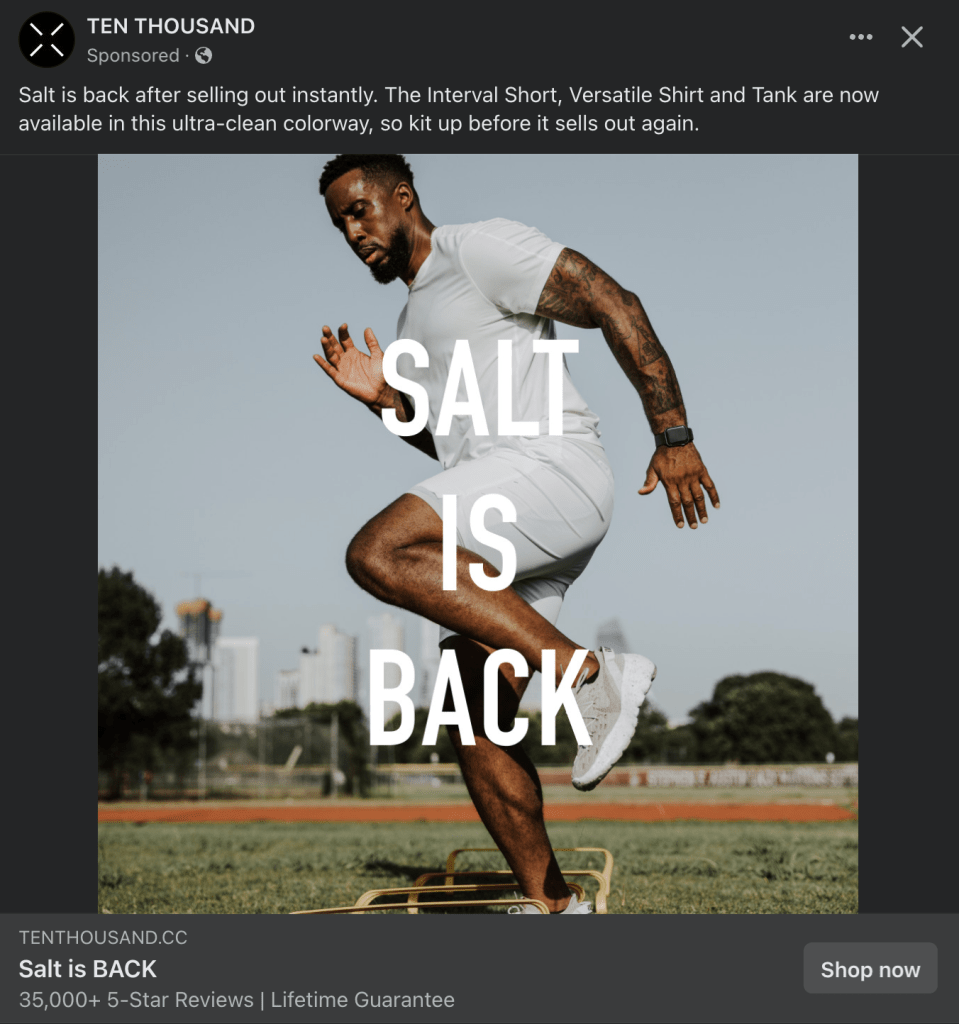
Not only is performance messaging clear for the above example, but you can see who the target audience is. The brand comes across in its creative direction with how it filters the image, including the text font.
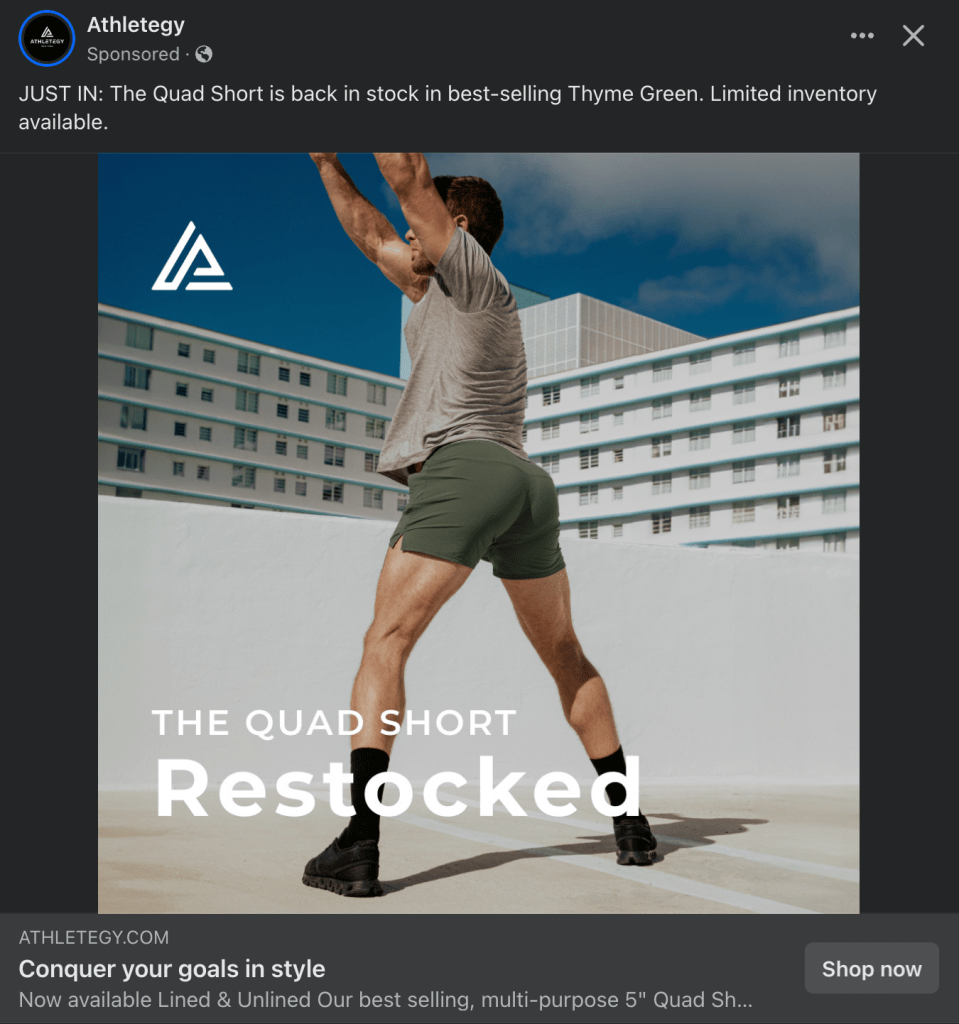
Or, as in the second example, the branding and the type of audience it is meant for are as clear as day, and I, for one, bought two pairs so my butt could maybe look like that.
That was an easy example, but what about something less known and leveraged, like the SMS channel? Can SMS be a performance channel while still being tongue-in-cheek for branding?
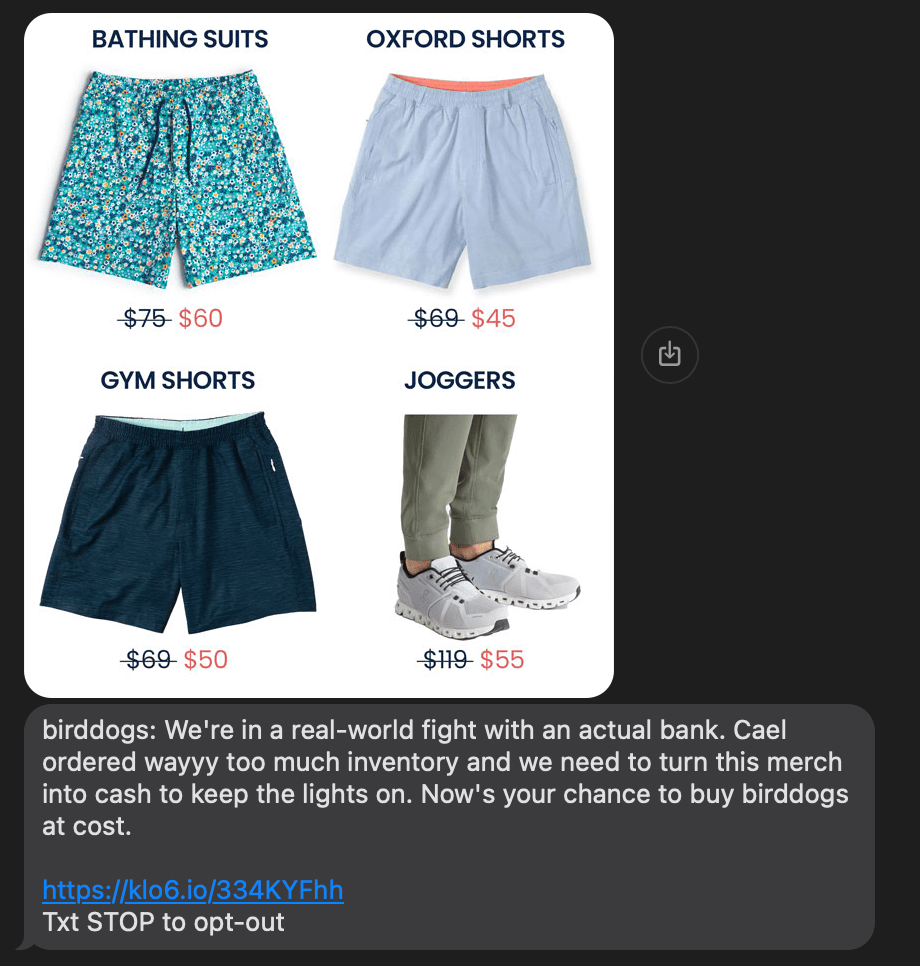
The example above is both performance-heavy and a tongue-in-cheek message to a returning customer (me) about how Birddog, the brand, is just a bunch of goofballs who have sales going on at the moment of the SMS.
My point is to upgrade your creativity and NEVER miss an opportunity to incorporate your branding into performance marketing, to bring life to your product in a sea filled with others like you. Be authentic to your audience, but, you know, don’t miss out on a sales conversion because you’re too busy being “different.”
I don’t believe any digital channel nowadays has a distinction difference between “brand” and “Performance” anymore. This isn’t the 2000s or 2010s where TV (offline) is “brand” and display (online) is “performance; just as technology has evolved, the line’s blurred for marketers, and our marketing theories must also evolve.
Embrace the Holistic Approach and Collaborate all the way to the Bank
I rarely see an ad that fluently crosses the border between brand and performance in enterprise organizations. The large organization likes to separate the two concepts because, as mentioned above, many marketers are identifying their space in the marketing world. It’s either I’m brand or I’m performance.
But to me, this is not just weakening your organization; it weakens you as a marketer. A marketer who knows how to be unique via brand but doesn’t know how to convert a customer is pointless in the short term because they aren’t going to make any money for the business. This is where smaller businesses and startups could (and sometimes) run circles around the enterprise brands.
I guarantee you that the level of performance from a small team at a startup that understands that performance and branding are one and the same will drive both performance and their brand to seem like they are everywhere all at once. Most algorithms like to reward high-performing ads; why can’t your high-performing ads also be sprinkled with the brand as a differentiating factor?
Shake Off the Useless Title
If you find yourself in either of the two camps in a large organization, quickly find your marketing brand or performance partner and begin to learn from them. Knowing how to build a brand and convert customers is vital to any organization.
I started out as a performance marketer, but nowadays, I return to the drawing board if the performance ad or creative that I either come up with or comes my way lacks one ounce of branding voice or differentiation. I won’t launch until I know there is a balance between branding and performance. But that’s just me.
 Nathan Nguyen Portfolio